ASEAN Summit in Cebu Proceeds with Austere Focus on Key Security Issues
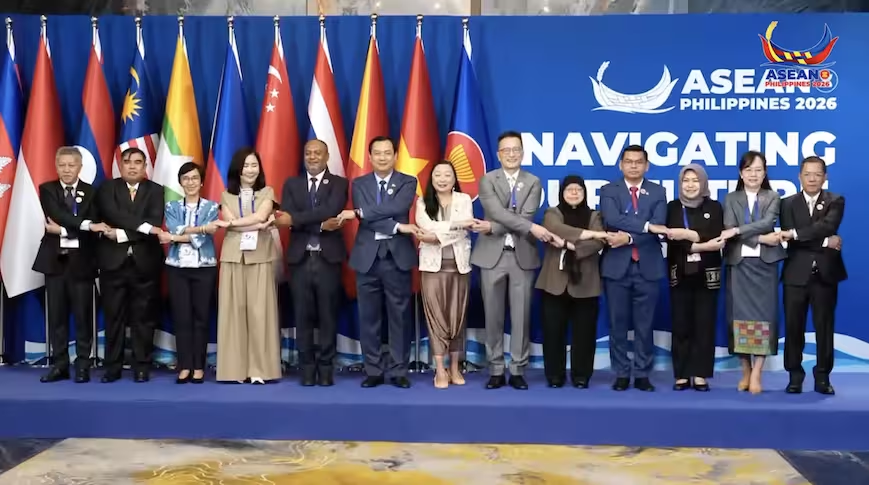
The picturesque island of Cebu, Philippines, recently served as the backdrop for a meeting of significant geopolitical weight. Far from the typical fanfare associated with large international gatherings, the ASEAN Summit convened with a notably austere and business-like atmosphere. With regional stability facing multifaceted challenges, leaders from the Association of Southeast Asian Nations (ASEAN) set aside pageantry to engage in frank discussions on the most pressing security issues confronting the bloc.
This focused approach underscores a critical juncture for ASEAN. The organization, often celebrated for its economic integration efforts, is increasingly being tested by traditional and non-traditional security threats that demand unity and decisive action. The Cebu summit, therefore, became a platform not for grand declarations, but for pragmatic dialogue and strategic alignment on the complex landscape of 21st-century Asian security.
The Core Agenda: Navigating a Multipolar Pressure Cooker
The summit’s agenda was dominated by issues that sit at the heart of regional peace and prosperity. The discussions reflected the delicate balancing act ASEAN must perform amidst the interests of global and regional powers.
Maritime Security and the South China Sea
Unsurprisingly, maritime disputes in the South China Sea remained a central, and deeply sensitive, topic. With multiple ASEAN member states having overlapping claims with China, the issue is a perennial test of the bloc’s cohesion. The discussions in Cebu aimed to reinforce the importance of:
- Peaceful resolution of disputes in accordance with international law, particularly UNCLOS.
- The full and effective implementation of the Declaration on the Conduct of Parties (DOC).
- Continued work towards an effective and substantive Code of Conduct (COC).
The austere tone of the summit likely facilitated more direct conversations about maintaining freedom of navigation and overflight, and the need to avoid actions that could escalate tensions in the vital waterway.
Myanmar’s Protracted Crisis
The ongoing political and humanitarian crisis in Myanmar presented another formidable challenge. ASEAN’s Five-Point Consensus, agreed upon in 2021, has seen limited progress, testing the organization’s credibility and principle of non-interference. In Cebu, leaders grappled with:
- Finding a unified path to encourage meaningful dialogue between the ruling military junta and opposition groups.
- Addressing the severe humanitarian fallout affecting millions of civilians.
- Balancing diplomatic pressure with the need for regional engagement.
The summit served as a crucial forum to reassess strategies and demonstrate ASEAN’s continued commitment to facilitating a peaceful solution in Myanmar.
Economic Security and Supply Chain Resilience
Beyond traditional geopolitics, the concept of security was broadened to include economic stability. In an era of global disruptions, from pandemic-related bottlenecks to geopolitical tensions, ensuring resilient supply chains is a paramount security concern. Discussions focused on:
- Strengthening regional food and energy security frameworks.
- Diversifying supply chains to mitigate over-reliance on single sources.
- Enhancing digital connectivity and cybersecurity cooperation to protect critical economic infrastructure.
The Austere Atmosphere: A Reflection of Serious Times
The choice to maintain a focused, low-ceremony environment was deliberate. This “Cebu Approach” sent several clear signals:
- Prioritization of Substance Over Symbolism: With urgent issues on the table, leaders minimized time spent on ceremonial aspects to maximize dialogue and problem-solving.
- Internal Cohesion is Key: The setting encouraged candid conversations behind closed doors, which are essential for building consensus among ten diverse member states with sometimes divergent interests.
- Acknowledgment of Gravity: The subdued tone reflected a shared understanding that the region’s challenges are serious and require sober, collective management.
This environment was conducive to addressing not only the “what” of security threats but also the “how” of ASEAN’s response mechanisms and central role in the regional architecture.
Implications for Regional Architecture and Global Partners
The outcomes and tone of the Cebu Summit have significant implications for the broader Indo-Pacific region and beyond.
ASEAN Centrality in the Spotlight
The summit was a live exercise in ASEAN Centrality—the principle that the bloc should be at the heart of the regional security architecture. By tackling tough issues internally first, ASEAN aims to present a more coordinated front to external partners, including China, the United States, Japan, and Australia. Its ability to manage internal disagreements and forge common positions directly impacts its influence on the wider stage.
Messaging to Major Powers
The focused dialogue in Cebu sends a message to all major powers that ASEAN is serious about managing regional stability. It underscores a desire for diplomacy and rules-based order, while also highlighting the bloc’s expectation that external powers respect its centrality and contribute constructively to regional peace.
A Template for Future Engagement?
The efficient, issue-driven model of the Cebu Summit may set a precedent for future ASEAN gatherings. As challenges grow more complex, member states may increasingly favor this style of engagement that prioritizes actionable outcomes and private diplomacy over public spectacle.
Conclusion: Steadfast Focus in a Complex World
The ASEAN Summit in Cebu may be remembered not for dramatic breakthroughs, but for its resolute and pragmatic focus. In choosing austerity over extravagance, the leaders demonstrated a collective recognition that the region’s security landscape demands undivided attention and mature diplomacy.
While the path forward on the South China Sea, Myanmar, and economic resilience remains fraught with difficulty, the summit provided an essential space for alignment and reaffirmed the necessity of ASEAN-led solutions. The work done in Cebu reinforces the bloc’s role as the indispensable hub for regional dialogue—a steady, if sometimes slow-moving, force navigating the turbulent waters of great power competition and internal strife. The true test, as always, will be in the implementation of the consensus built in those quiet meeting rooms, translating discussion into tangible actions that ensure a secure and prosperous future for all of Southeast Asia.