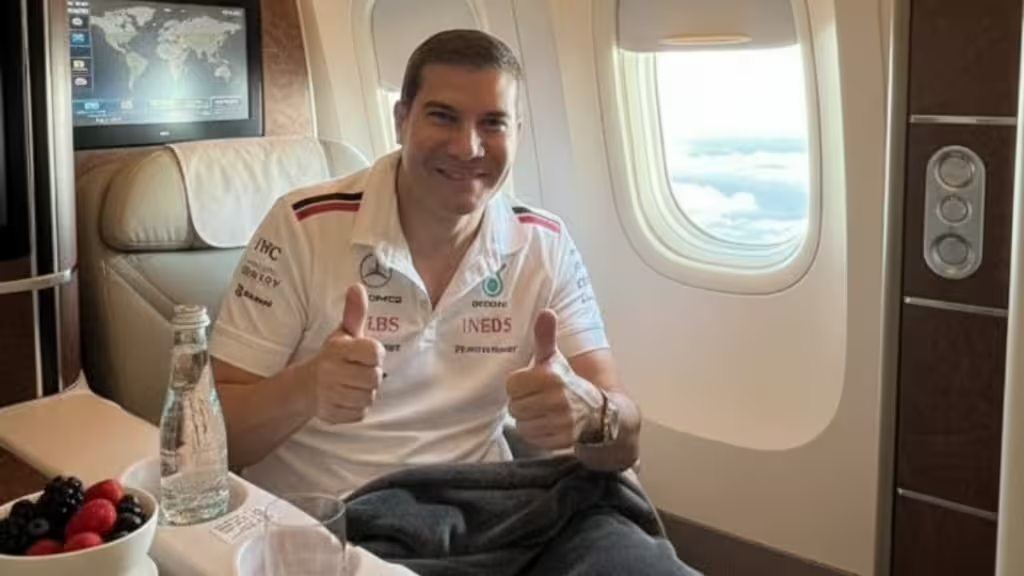
Edu Manzano Says Traveling Abroad Reveals What Filipinos Deserve
For many Filipinos, traveling abroad is a dream—a chance to see new sights, experience different cultures, and perhaps find better opportunities. But for veteran actor and TV host Edu Manzano, international travel has become more than just a personal adventure; it’s a lens through which he sees the stark contrasts in public service and infrastructure, revealing a powerful truth about what his fellow citizens truly deserve.
In a recent, candid conversation that has resonated across social media, Manzano shared his observations from his travels, sparking a national conversation about standards, accountability, and the potential of the Philippines.
The Eye-Opening Journey: Contrasts in Public Service
Manzano didn’t just talk about beautiful landmarks or exotic food. He focused on the mundane, everyday systems that citizens in many other countries take for granted but are often points of frustration in the Philippines.
His core message is profound yet simple: by witnessing how efficient, clean, and user-friendly public systems can be elsewhere, Filipinos can better understand that the challenges they face at home—from traffic congestion to bureaucratic red tape—are not inevitable. They are the result of specific choices and governance styles.
Observations from Abroad: A Benchmark for Excellence
While Manzano spoke broadly, his implications point to tangible areas where the gap is most visible:
- Transportation Systems: The reliability and cleanliness of trains, the organization of bus networks, and the overall seamlessness of public transit in countries like Japan, Singapore, or parts of Europe stand in sharp contrast to the chronic issues plaguing the Philippines’ transport infrastructure.
- Civic Order and Cleanliness: The discipline in following rules, maintaining clean public spaces, and a general sense of order in many destinations highlight how public behavior and effective governance reinforce each other.
- Efficiency of Public Services: The experience of dealing with government offices or public utilities abroad, where processes are often streamlined and digitized, underscores the potential for improvement back home.
More Than Criticism: A Call for Elevated Standards
It’s crucial to frame Manzano’s statements not as mere criticism of the Philippines, but as a passionate call to action. His perspective is born from a belief in the Filipino people’s worth.
“Seeing how it’s done elsewhere shows us it’s possible,” he seems to say. The comfort, efficiency, and respect experienced by citizens and travelers in other nations should not be seen as a privilege exclusive to them. It is a baseline standard that all people, including Filipinos, should rightfully expect from their leaders and public institutions.
This reframes the desire for better infrastructure from a “want” to a “deserve.” It challenges the sometimes pervasive notion that Filipinos must simply endure hardship, suggesting instead that they should actively demand better.
The Role of Leadership and Collective Action
Manzano’s commentary subtly points a finger at governance. The quality of public service is directly tied to the vision, competence, and integrity of those in power. When leaders prioritize grand, short-term projects over the unglamorous work of maintaining trains, streamlining permit processes, or enforcing clear rules, the public’s daily experience suffers.
However, he also hints at a shared responsibility. The discipline and civic-mindedness observed abroad are also cultural traits that can be nurtured. It’s a two-way street: leaders must provide good systems, and citizens must engage with them respectfully and responsibly.
Why This Message Resonates Deeply
The reason Manzano’s words have struck a chord is that they articulate a feeling shared by millions of Filipinos, especially the vast Overseas Filipino Workers (OFW) community and frequent travelers.
- The OFW Perspective: Millions of Filipinos working abroad experience this contrast daily. They operate within efficient systems in their host countries, only to return home to face outdated and frustrating processes. Manzano gives voice to their silent comparison.
- The Aspirational Youth: Younger Filipinos, more connected to the world through the internet, see global standards. They wonder why such standards seem out of reach in their own country and are inspired by calls to demand more.
- A Unifying Sentiment: Beyond political divides, the desire for a comfortable, efficient, and orderly public life is universal. Manzano’s non-partisan framing focuses on the common citizen’s experience, making it a widely relatable issue.
From Realization to Reality: The Path Forward
Awareness is the first step, but the crucial question is: what comes next? Edu Manzano’s observations should serve as a catalyst for concrete change.
For citizens, it means becoming more engaged and discerning voters, holding officials accountable not for their promises but for tangible improvements in daily life. It means adopting a more proactive and disciplined approach to civic life, from following traffic rules to properly disposing of waste.
For leaders and policymakers, the mandate is clear. The benchmark is no longer just the city or province next door; it is the global standard. Investments must be made in sustainable, intelligent infrastructure. Policies must be designed with user experience—the citizen’s experience—as the top priority. Corruption and inefficiency, which directly rob people of the service they deserve, must be relentlessly addressed.
A Vision of a Philippines That Filipinos Deserve
Edu Manzano, through his personal travels, has held up a mirror to the nation. The reflection shows not just what is, but what could be. He champions a Philippines where a commute is predictable and comfortable, where dealing with a government office is straightforward, and where public spaces are clean and safe.
This is not a fantasy. It is the reality in many nations at similar stages of development. It is achievable. By internalizing the idea that they deserve better systems, Filipinos can transform their collective aspiration into an unwavering demand for the competent, transparent, and service-oriented governance that will make it a reality. The journey abroad, as Manzano illustrates, is ultimately about finding the direction for the journey at home.