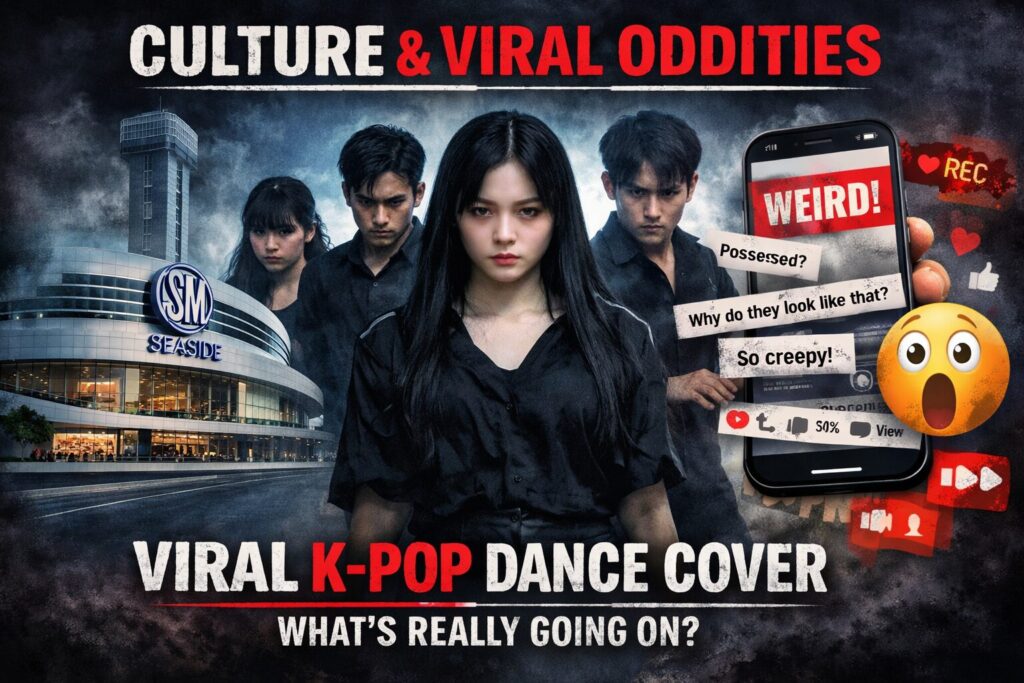
You scroll past another dance cover video.
Then you stop.
Something feels off.
The clip shows a K-pop dance group performing inside SM Seaside Cebu.
The moves look sharp.
The timing feels exact.
Yet people online say it looks unnatural.
Some even call it disturbing.
Here’s what actually caught attention.
• The dancers move in perfect sync
• Their faces barely change
• The transitions look abrupt
• The energy feels intense
You start asking questions.
Why does this feel different from other covers?
Where it happened
The video was filmed inside SM Seaside.
A public mall.
A familiar place.
You expect casual performances here.
Crowds.
Noise.
Distractions.
Instead, the dancers stay locked in.
No eye contact with passersby.
No missed beats.
No visible reaction to the crowd.
That contrast fuels the reaction.
What people noticed first
Viewers pointed out the movements.
• Sharp head snaps
• Sudden stops
• Stiff posture between steps
One comment said the dancers moved like machines.
Another said the timing felt too exact.
You may have seen dance crews nail hard routines before.
This felt different to many viewers.
Not better.
Just strange.
Facial expressions raised questions
Most dance covers rely on expression.
Smiles.
Attitude.
Stage presence.
In this video:
• Faces stay blank
• Eyes remain fixed
• Emotions look controlled
Some viewers replayed the clip to check if it was edited.
Others slowed it down frame by frame.
You might do the same.
Why the word “possessed” spread
No one claimed anything literal.
It was a reaction word.
People used it because:
• The movements looked rigid
• The expressions stayed frozen
• The vibe felt tense
Social media rewards shock.
Strong words spread faster.
You’ve seen this pattern before.
A strange clip.
A loaded label.
A viral spiral.
The role of choreography
K-pop choreography demands precision.
Clean lines.
Strong hits.
Uniform timing.
Some groups train for years to reach that level.
If you’ve danced before, you know the drill.
You repeat moves until they feel automatic.
Your face relaxes.
Your body takes over.
To a casual viewer, that can look eerie.
Camera angle matters
The clip appears shot from a fixed angle.
No cuts.
No close-ups.
That changes perception.
• No smile checks
• No reaction shots
• No crowd context
You only see movement.
That isolation amplifies the effect.
Mall performances feel personal
When dancers perform on stage, you expect intensity.
Lights.
Sound systems.
Distance.
In a mall, you’re close.
You see faces.
You notice stillness.
You feel tension.
That closeness can unsettle you.
Online reactions escalated fast
Comments ranged from curiosity to fear.
• “Why do they look like that?”
• “Is this edited?”
• “Why does this feel wrong?”
Others pushed back.
They explained training.
Discipline.
Control.
You see two camps form.
Reaction versus reason.
No signs of foul play
There’s no evidence of tricks.
No glitches.
No cuts.
Just a group dancing.
The fear comes from interpretation.
Not facts.
That matters.
Why your brain reacts this way
Your brain expects patterns.
When something breaks expectation, alarms go off.
You expect dancers to smile.
They don’t.
You expect crowd interaction.
You see none.
Your brain fills the gap.
Similar cases before
This isn’t new.
Other dance videos triggered the same response.
• Street performances with blank faces
• Flash mobs with sudden starts
• Military-style routines
The common factor is control.
Too much control feels unnatural to some viewers.
Social media amplifies emotion
Platforms reward reaction.
Calm analysis rarely trends.
Fear spreads faster.
You may share before thinking.
Others pile on.
Suddenly, a normal video feels sinister.
What dancers say about it
Dancers often focus inward during routines.
They count beats.
Track spacing.
Hold posture.
Expression becomes secondary.
If you’ve performed, you know the tunnel vision.
What you should take from this
Before reacting, pause.
Ask yourself:
• What am I really seeing?
• Is this skill or something else?
• Am I reacting to the dance or the comments?
Your reaction says as much about context as content.
Why this clip went viral
It hit a mix of factors.
• Public space
• Precise movement
• Neutral expressions
• Loaded captions
That combination hooks attention.
Final thought
Not every strange feeling signals danger.
Sometimes it signals unfamiliar skill.
The next time you see a clip like this, watch twice.
Once with emotion.
Once with logic.
Your perspective may change.