For decades, the turquoise waters and pink sands of Bermuda have attracted tourists, but the island itself has been a geological enigma.
Scientists have long puzzled over the volcanic origins of this remote outpost in the North Atlantic, particularly because its formation didn’t fit the standard model of how such islands are created. The mystery, often loosely linked to the legendary Bermuda Triangle, now has a concrete, scientific explanation.
A team of geoscientists has finally peered deep beneath the ocean floor and uncovered a rare, massive geological structure that rewrites the history of the Atlantic.
This discovery is not just about filling in a blank space on a map; it solves a paradox that has frustrated geologists for 30 years. The key to the puzzle lies in a unique formation—a literal “keel” of rock that is unlike almost anything else found on Earth.
The Bermuda Paradox: An Island That Shouldn’t Be Here?
To understand why this discovery is so significant, we need to look at the classic narrative of island formation.
Most islands in the middle of an ocean, like Hawaii or the Azores, are created by a “hotspot”—a plume of superheated magma rising from deep within the Earth’s mantle. As tectonic plates move over this stationary plume, volcanoes erupt, building islands.
Bermuda was long assumed to be a hotspot island. The evidence is visible: the island is capped by a thick layer of volcanic basalt. However, the timeline never made sense.
The 30-Year Geological Riddle
- The Age Gap: The volcanic rocks on the surface are about 30 million years old. But the geological evidence of the hotspot plume indicated that the magma source should have been active under Bermuda much more recently—within the last 10–15 million years.
- The “Magmatic Gap”: If the hotspot existed as predicted, the crust beneath Bermuda should be thick and heavily intruded by fresh magma. Yet, standard seismic surveys consistently showed a surprisingly thin crust.
- The Discrepancy: Geologists could not find the volcanic bulge or the active magma chamber they expected. The island’s geology flatly contradicted the fundamental physics of plume theory.
This led to a frustrating question: Was there a hotspot here or not? And if not, what created this island?
The Discovery: A Giant “Lava Pimple”
The breakthrough came when a team from the University of Southampton and elsewhere deployed advanced ocean-bottom seismometers.
Instead of looking for the standard volcanic conduit, they listened for the “echo” of deep seismic waves. What they found was not a typical magma chamber, but a colossal, solidified blob of rock sitting directly beneath the island.
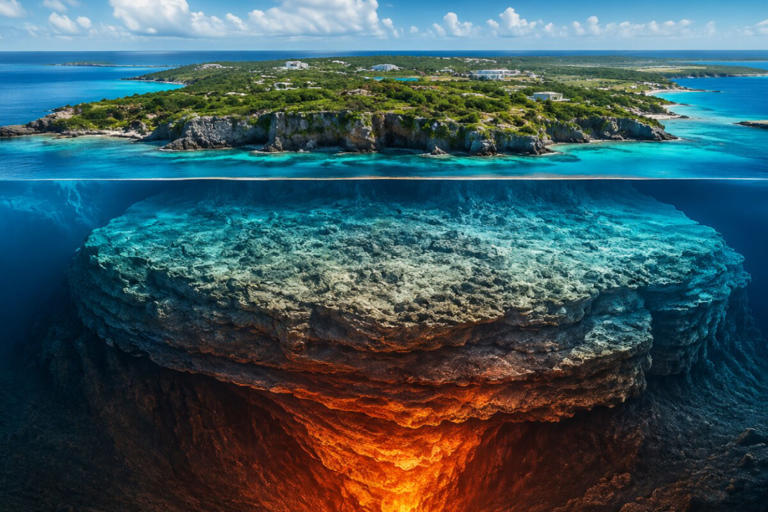
This formation is technically known as a magmatic keel.
Imagine turning an island upside down and looking at the root system. This is a massive, dense body of ancient, crystallized magma. But this is not just any old magma.
What Makes This “Keel” So Rare?
The Bermuda magmatic keel is unique. It is only the second confirmed structure of its kind on the planet, and the first to be found under an island in the Atlantic.
Here are its defining characteristics:
- Massive Scale: The keel extends deep into the Earth’s mantle, pushing the boundary between the crust and mantle (the Mohorovičić discontinuity) from its normal depth of about 10 kilometers down to nearly 24 kilometers below sea level. This is a massive vertical intrusion.
- Arid Magma: This is the most important detail. The magma that formed this keel did not originate from a deep, hot plume. It came from a “cold” and dry part of the mantle. It was rich in silica and poor in water—a composition that usually remains stuck deep in the Earth.
- Slow Motion Eruption: Instead of a violent volcanic explosion, this formation created a slow, deep intrusion. The magma got “stuck” as it tried to rise, cooling and crystallizing into a hard, dense plug.
This solves the paradox. The crust is not thin because it was built from the bottom up, not the top down.
How the Rare Formation Finally Explains the Mystery
The discovery of this keel turns conventional hotspot theory on its head for this region. The solution is that Bermuda was formed by a fundamentally different geological process.
The “Mantle Avalanche” Theory
Researchers believe the catalyst was a massive instability in the mantle. Not a plume rising from the core-mantle boundary, but a “slab avalanche.”
For millions of years, the North American tectonic plate was subducting (sliding under) the Caribbean plate on one side, and the European plate on the other.
As these cold, dense slabs of ancient ocean floor sank into the mantle, they displaced hot, deep material. This disturbance triggered a secondary upwelling of mantle material at a shallower depth.
Step-by-Step Formation of the Atlantic Anomaly
- The Trigger: A massive “avalanche” of sinking rock in the mantle created a low-resistance pathway for magma.
- The Intrusion: This unique, water-poor magma rose rapidly through the mantle, punching through the crust like a molten cork.
- The Freeze: Because the magma was relatively “cold” (in geological terms—still over 1000°C) and dry, it hit the crust and froze solid quickly, creating the thick keel.
- The Aftermath: The initial flood of magma created the volcanic island we see today. However, the frozen keel choked the conduit. This explains why the volcanic activity stopped abruptly 30 million years ago, leaving no trace of the younger hotspot activity geologists were searching for.
Implications for a Resurgent Atlantic
This finding is a game-changer for understanding the Atlantic Ocean’s geology. It suggests that the evolution of the ocean floor is more complex than the simple “plume” model.
What This Means for Earth Science
- Rethinking Mantle Dynamics: The discovery proves that “secondary” convection—triggered by the sinking of tectonic slabs—is a powerful force for creating land. We can no longer assume that all intra-plate islands are the product of deep mantle plumes.
- The Future of the Atlantic: The mantle beneath the Atlantic is still “recovering” from the breakup of the supercontinent Pangea. As old slabs continue to sink, we may see more of these “keel” formations, and potentially, new volcanic activity in the region.
- A New Class of Volcano: The Bermuda keel represents a new type of volcanic formation—a “rapid, short-lived, low-water” event. This changes how we predict volcanic hazards in other parts of the world.
The Ultimate Takeaway
For those fascinated by the “Bermuda Triangle,” the mystery has been solved, but the answer is far more profound than magnetic anomalies or rogue waves.
The truth is that a giant, ancient “lava pimple” is sitting under the island, plugging the hole that connected the ocean to the deep Earth.
This rare formation explains the unexplained chronology and provides a stunning new piece of the puzzle regarding how our planet builds islands.
The ground beneath Bermuda is not just a tropical paradise—it is a frozen time capsule of a rare and violent event that reshaped the Atlantic floor.