What the Cebu Minimum Wage Looks Like After October 14, 2026
Two workers on the same island now have different legal pay floors. A worker in Mandaue City is covered by a ₱582 daily minimum, while a worker in Toledo City is covered by ₱542. The ₱40 gap comes from how Wage Order No. ROVII-27 sorts places into classes.
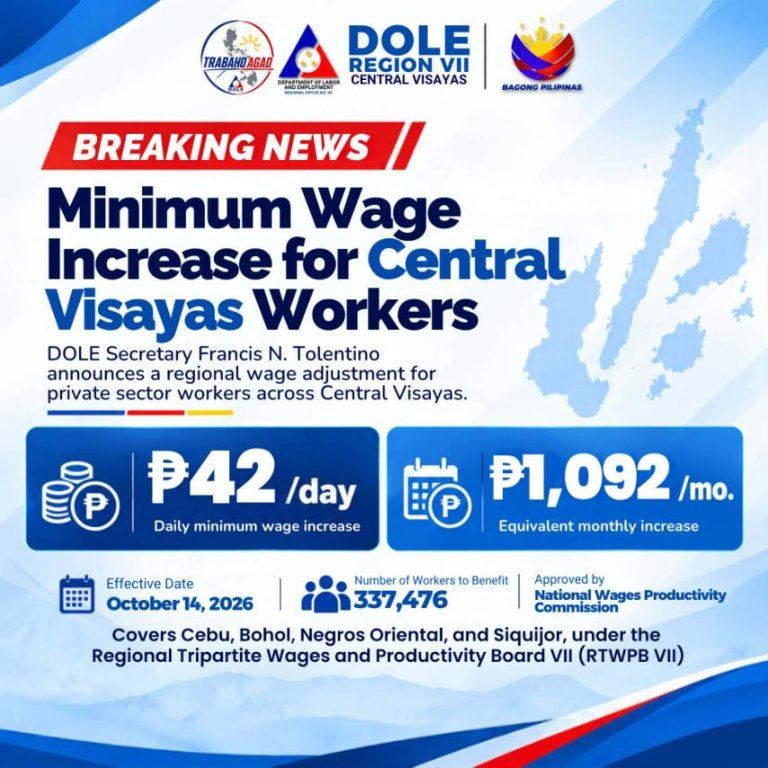
That order raised basic pay by ₱42 per day across Region VII, also known as Central Visayas. For anyone tracking the Cebu minimum wage, the headline numbers are simple: Class A moves from ₱540 to ₱582, and Class B moves from ₱500 to ₱542.
The Regional Tripartite Wages and Productivity Board VII issued the order on 14 September 2026. It was published on 28 September 2026 in The Freeman newspaper, and the new rates took effect on 14 October 2026.
The board did not decide in a vacuum. It held consultations in Bogo, Tagbilaran, and Balamban, Cebu, plus public hearings in Cebu City and Dumaguete, before the order came out.
Class A: Metro Cebu and Nearby Towns at ₱582
Class A is the higher tier, and it covers the busiest parts of the island. The cities on the list are Carcar, Cebu, Danao, Lapu-Lapu, Mandaue, Naga, and Talisay.
Several municipalities sit in the same tier: Compostela, Consolacion, Cordova, Liloan, Minglanilla, and San Fernando. The order ties this group to Expanded Metro Cebu.
If you run a shop in Lapu-Lapu or manage a small office in Mandaue, the new floor for your staff is ₱582 per day. Domestic workers are covered by a separate order, which comes up further down.
Class B: Everywhere Else at ₱542
Class B takes in every city and municipality not listed under Class A. Among the cities that land here are Bais, Bayawan, Bogo, Canlaon, Dumaguete, Guihulngan, Tagbilaran, Tanjay, and Toledo.
The split can be sharp even between towns on the same island. Danao sits in Class A at ₱582, while Bogo falls in Class B at ₱542.
One detail needs a second look. Negros Oriental and Siquijor are now part of the Negros Island Region, yet their cities and municipalities remain covered by Wage Order No. ROVII-27, specifically under Class B.
Domestic Workers, Transport, and Exemption Applications
Household help falls under a different order, Wage Order No. ROVII-DW-06. It lifts the minimum from ₱7,000 to ₱7,500, an increase of ₱500, and it also took effect on 14 October 2026.
This rate covers Central Visayas and the provinces of Negros Oriental and Siquijor. Unlike the main order, it does not split into Class A and Class B, so the same ₱7,500 figure applies across that whole area.
Transport has its own story. The board’s news page lists a June 2026 item on a two-tiered wage system for Cebu’s transport sector. The page shows only the headline, so drivers and operators should open that item for the details.
Employers who want to apply for exemption from Wage Order No. ROVII-27 will find a checklist and an annex posted on the board’s page as PDFs.
Frequently Asked Questions About Cebu Wage Rates
When did the new rates start?
Both Wage Order No. ROVII-27 and Wage Order No. ROVII-DW-06 took effect on 14 October 2026. The increase for regular workers is ₱42 per day.
How do I know if my town is Class A or Class B?
Class A covers the cities of Carcar, Cebu, Danao, Lapu-Lapu, Mandaue, Naga, and Talisay, plus Compostela, Consolacion, Cordova, Liloan, Minglanilla, and San Fernando. Any other city or municipality under the order is Class B. If your location is unclear, confirm it with the board directly.
Where can I ask questions about compliance?
The Regional Tripartite Wages and Productivity Board VII is on the 6th floor of the DOLE VII Building, Gorordo Avenue, Kamputhaw, Cebu City. You can call (032) 266-80-68, message the Viber line at 0992-855-4581, or email rb7@nwpc.dole.gov.ph.
What to Check Before You Plan Around These Rates
Start by confirming which class your municipality belongs to, since a ₱40 difference adds up quickly over a month of payroll. Then download the two wage order PDFs from the National Wages and Productivity Commission site, Wage Order No. ROVII-27 for regular workers and Wage Order No. ROVII-DW-06 for domestic workers.
If you employ drivers, read the June 2026 transport item as well. If exemption might apply to your business, get the checklist and annex from the board’s page before you submit anything.
The rates page was last updated on 28 September 2026, so check it again before you finalize budgets. Anything that changes after that date will show up there first.